The Nature of Light and Color
We Perceive the Universe, but What We See Exists Only in Our Minds
Anonym
The natural phenomena of light and color are intimately involved with our daily existence, as well as being at the center of much of the science and technology that many of us dedicate our professional careers to. Yet a detailed understanding of these phenomena is not common. In this and perhaps subsequent articles, we will survey these topics at what hopefully will be a clear and approachable level for the general reader.
One fascinating aspect of this subject is that the sensation of vision - like each of our senses - is a psychological interpretation of our physiological response to physical stimuli. We are used to dealing with the physics of the interaction with light and matter, but the sensation of sight occurs in the brain. What someone 'sees' is effectively subjective - wholly contained within their mind, and usually not measurable.

"Cloud in the sunlight" by Ibrahim Iujaz from Rep. Of Maldives. Licensed under CC BY 2.0 via Commons
Basic scientific literacy includes an understanding that light is a category of electromagnetic radiation, alongside radio waves, gamma and x-rays, etc. Electromagnetic waves propagate energy in all directions through the universe, interacting with matter which both absorbs and radiates these waves. Visible light exists in the portion of the electromagnetic spectrum that extends between wave lengths of around 350 nm up to 750 nm. Just outside of this range lies infrared radiation with longer wavelengths and shorter wave ultraviolet.
All electromagnetic waves basically behave exactly the same, which is not surprising considering that they are all manifestations of the same phenomena. For example, all electromagnetic waves travel through space at the same speed - the speed of light - and have the property that as the wavelength decreases along the spectrum, their frequency increases. The differences that exist between different electromagnetic waves are really just a matter of degree, and exist due to the differences in frequency (or inversely, wavelength). Light waves, which we usually take to mean visible light waves, are unique only due to their visual qualities. The concept of color as we usually think of it really only has meaning in the context of visible light.
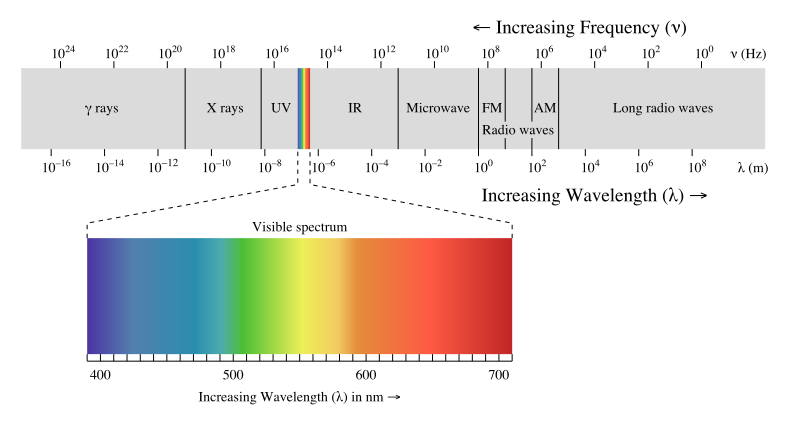
"EM spectrum". Licensed under CC BY-SA 3.0 via Commons
The term visible indicates frequencies that can be detected by that most versatile radiation sensor in existence - the eye. Its sensitive retinal inner surface photo-chemically responds to incoming light rays, turning them into weak electrical impulses that are sent to the brain for interpretation. What we perceive - the sense of vision - occurs entirely within the brain of the observer, meaning that it is both subjective and for the most part impossible to measure.
Brightness, for example, is a completely psychological concept. It is a sensation that is experienced in the mind of the observer, and is not measurable by instruments. The eye is so adaptable to varying levels of illumination that it is an extremely poor detector of absolute brightness levels. When considering illumination, we talk about the intensity of the light source, a quantity of which depends on the total amount of light emitted by the source in a given direction. Brightness is associated with the amount of light stimulus experienced by an observer. It corresponds to the perception of light-source intensity per unit area. This measurable quantity, luminance, is an example of a psychophysical variable, linking a psychological response - brightness, in this case - to a related physical aspect.
For most of human history, people thought that light was colorless and only revealed an object's intrinsic property of color through illumination. It wasn't until 1630 that Descartes attributed the color of an object to some change in the light that is reflected off of the object. All objects reflect, absorb and potentially transmit incident light in some combination due to their physical structure, and the variance of that response in term of wavelength is interpreted as the sensation of color to an object's observer. It happens so naturally that it is easy to discard how intricate an experience color vision is. When you look at an object, the color that you see depends on the frequencies and intensities of the light illuminating it, the frequencies of the light that is reflected or transmitted by it, the color of objects that are adjacent to it, and on any absorption, reflection and transmission by materials in the ray path between you and the object.

"Goethe, Farbenkreis zur Symbolisierung des menschlichen Geistes- und Seelenlebens, 1809" by
Luestling ; Licensed under Public Domain via Commons
The psychological aspects of the sensation of color vision are hue, saturation, and brightness, none of which can be directly measured. Since color cannot be accurately specified by physical aspects, we rely on the related psychophysical variables of dominant wavelength, purity and luminance.
Hue is the sensation through which we distinguish the variability of the spectrum, from red to yellow to green to blue, and so on. Most color samples can be matched by adding some monochromatic (pure) light to white light. The wavelength of that light is called the dominant wavelength.
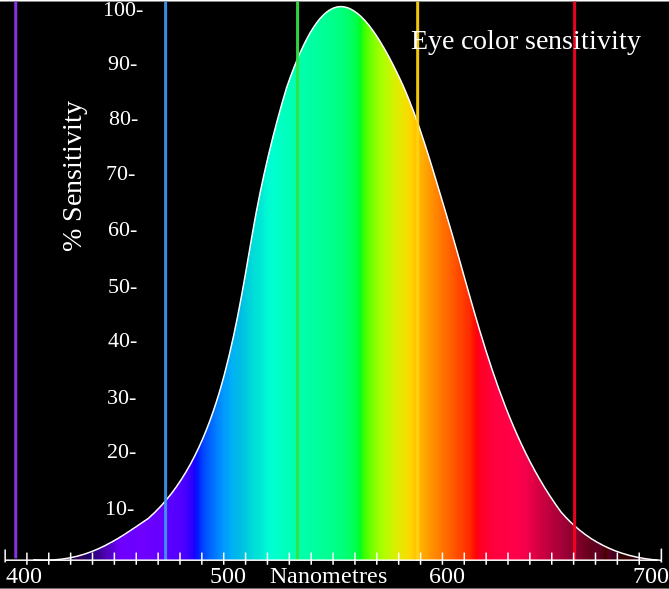
"Eyesensitivity" by Skatebiker, vector by Adam Rędzikowski - File:Evesensitivity.svg, vectorised. Licensed under CC BY-SA 3.0 via Commons
Saturation is the sensation that derives from the relative amount of hue in a color. Purity is the psychophysical variable that relates to saturation. It is the ratio of the amount of monochromatic light to the amount of white light in a color sample. Monochromatic light has a purity of 100%, white light 0%.
Although hue, saturation and brightness (the sensation dependent on the overall amount of luminance) are the three components of color perception, they are not independent of each other. Changing one of the qualities often results in changes to the other two.
Without having to get into all the complexities of the subject, it is clear that light and color are essential to our every day lives and an essential part of human technology. Compositions of alloys, the molecular identification of various materials, the temperature of a distant star, as well as its chemical constitution and velocity - all of these can be determined by the analysis of light and color. Light and color in many ways are the the key means by which humans interface with the world and derive meaning from it. This is a topic that we may find interesting when we contemplate the interpretation of image analysis.

Light dispersion of a mercury-vapor lamp with a flint glass prism IPNr°0125" by D-Kuru - Own work. Licensed under CC BY-SA 3.0 at via Commons