X

NV5 Geospatial Blog

Each month, NV5 Geospatial posts new blog content across a variety of categories. Browse our latest posts below to learn about important geospatial information or use the search bar to find a specific topic or author. Stay informed of the latest blog posts, events, and technologies by joining our email list!


Using ENVI and IDL Agents with Your Own API Keys

Using ENVI and IDL Agents with Your Own API Keys

6/22/2026

Earlier this year, we introduced the ENVI® Agent and IDL® Agent to bring intelligent, AI-driven automation to your geospatial and data science workflows. If you missed the launch, you can catch up on the full breakdown by watching our release webinar. Both agents are built upon GitHub Copilot, a powerful AI orchestration... Read More >

What We're Looking Forward to at Esri UC 2026

What We're Looking Forward to at Esri UC 2026

6/16/2026

Every year, the Esri User Conference brings together thousands of geospatial professionals to explore new technologies, share ideas, and learn how organizations are solving complex challenges with GIS. For many members of the NV5 team, attending Esri UC is an annual tradition. Some have attended for more than 15 years. Others will be... Read More >

New ENVI Agent, IDL Agent, and GeoAgent Quick Guides

New ENVI Agent, IDL Agent, and GeoAgent Quick Guides

6/9/2026

The recent release of ENVI® Agent, IDL® Agent, and GeoAgent™ revolutionize how users interact with geospatial software. These agentic AI applications act as partners to plan, simplify, and execute complex workflows. Knowing where to start can be challenging for new users. To this end, we developed three new quick guides to... Read More >

Introducing NISAR Data Support

Introducing NISAR Data Support

6/5/2026

The release of ENVI® SARscape 6.3 in April 2026 includes preliminary support for NASA-ISRO SAR (NISAR) data. The NISAR mission is a joint Earth-observing satellite project between NASA and the Indian Space Research Organization designed to monitor changes in the planet’s land and ice surfaces using advanced radar imaging. It... Read More >

Monitoring Illegal Mining in the Amazon: Turning Persistent Data Into Actionable Insight

Monitoring Illegal Mining in the Amazon: Turning Persistent Data Into Actionable Insight

5/28/2026

Illegal mining over decades has constituted one of the most persistent and complex socio-environmental problems in the Brazilian Amazon. In recent years, with the increasingly intensive use of mechanized extraction, the associated environmental impacts—such as deforestation, intense soil disturbance, river siltation, and mercury... Read More >

1345678910Last
29441 Rate this article:
No rating

UAV or UAS? The Future of Remote Sensing

Anonym

When thinking about imagery, I am enchanted on a daily basis about how we can utilize technology to capture information we cannot "see". We can then manipulate the information in such a way that something otherwise “invisible” actually becomes obvious. Let’s take a minute to have some fun looking at the obvious. Do these icons look familiar?

Yes, it is a computer mouse that actually looks like a mouse and Kramer’s infamous coffee table book about coffee tables. So what on earth – or more accurately, what in the sky, has sparked my recent inquisition? Checkout Aerovironment’s Nano Hummingbird UAV that looks like (and even moves like) an actual hummingbird:
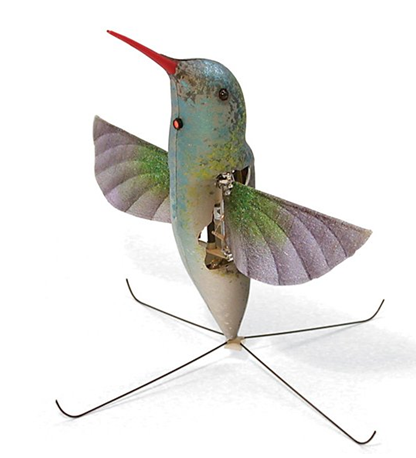
Image recently published in Earth Imaging Journal | Aerovironment site


This month alone there were three articles published in Earth Imaging Journal (EIJ) that touched on various topics related to unmanned aircraft. In fact, according to the article by Michael Hutt from the USGS (USGS UAS Program Does More with Less) the unmanned aircraft integration into the national airspace system (NAS) will create more than 70,000 new US jobs and grow the market segment to $13.6 billion within three years of integration. Recent influx of UAV applications in the news, industry journals, and even from my customers, supports this growth theory as do the rapid advances in technical capabilities of these small ‘birds’.

While we are on the cusp of a new era in remote sensing technology, the terminology is still catching up and has yet to completely work itself out. If you Google UAV vs. UAS you will quickly find that there has been a great debate about which term is “correct” and how these acronyms may become distinguished from one another in the near future.

UAV or UAS?

What is most similar between the two and also what distinguishes these aircraft from remote control planes is that these aircraft have pilots at a ground station in continuous control of the vehicle at all times. This is true whether the aircraft can be seen from the ground or not. So what distinguishing features separate a UAV from a UAS?

According to the Association for Unmanned Aerial Vehicle Systems International (AUVSI), a UAV incorporates “…lightweight airframes, advanced propulsion systems, secure data links, and high technology control systems and payloads.”

As the industry moves forward the platform itself is rapidly becoming distinguished from the advanced aspects of deployment and compliance requirements with NAS regulations. Compliance will be greatly dependent upon the ability to implement safety regulations. Tasks such as radio communication, capture systems, and even implementation of sense-and-avoid technologies will be controlled at these ground stations. Thus the “S” in UAS encompasses the system in its entirety.

I am personally excited to follow and learn how the UAS industry continues to evolve and look forward to the opportunity to work on more UAS applications. Will you be using an unmanned aircraft in the future?

1 comments on article "UAV or UAS? The Future of Remote Sensing"

Avatar image

lopuu

It is nice playing rc planes, and its my hobby too since i was in 12 yrs old. This is a good project for all rc plane collectors in which they can donate some charities to less fortunate people. tiger coupons

Please login or register to post comments.